

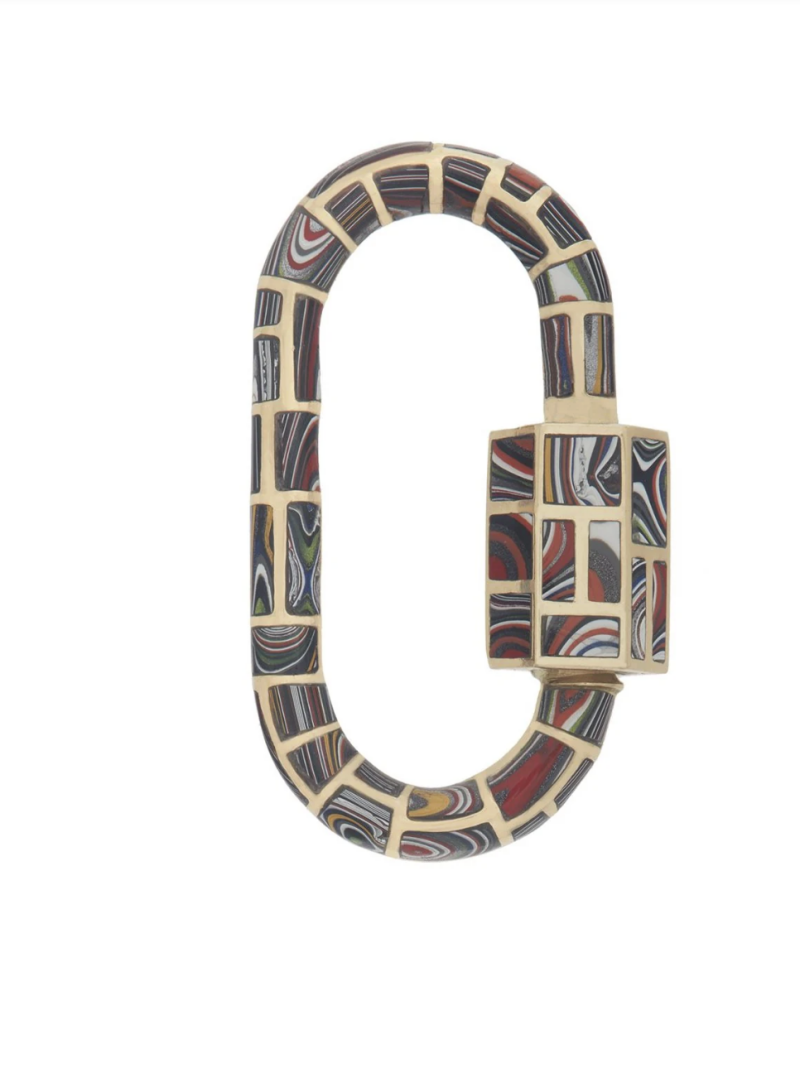
When I heard about the use of layers and layers of car paint that is taken from the floor of the old Ford factory (This material is called Fordite) I send Lola a message "can we do our next blog about unexpected materials in fashion?"
Fordite is a by product of the automotive industry and was sort of accidently 'discovered' when paint waste had to be removed because it clogged machinery. The beautifull multicoloured material material (also called Detroit agate or motor agate) looks like a gemstone— but it’s actually layers of hardened car paint. In the 40's it was collected by some workers and polished and cut into jewelry and art objects. Nowadays, modern car factories use electrostatic painting, where paint is magnetically attracted to the car, meaning that the build up of paint layers is not created anymore. This makes Fordite a rare and historical material. I love the idea of the story this material tells, and the fact that is was placed in a complete differend context.


These stunning disks are
unique pieces of the
Marla Aaron Fordite collection, as is the inlay lock besides it.


On a dive in the archives of Vogue these pages from 1967 (top) and 2003 (left) show some brilliant designs of Spanish designer Paco Rabanne.
When things get Unexpected it definitely gets my Attention.
The master of using and integrating unexpected materials is in my opinion Paco Rabanne. He debuted with a collection in 1966 with the title "12 Unwearable Dresses in Contemporary Materials" This title by itself is (especially for time) already an rebellious act. This would later caused the start of the Space-Age aesthetic that was reinforced by an other rebellious designer, Courréges.
These weren’t “pretty clothes” — they were statements about the future, technology, women’s bodies, and freedom.
Rabanne became famous for doing things that felt almost offensive to traditional couture at the time.
Coco Chanel reportedly called him “a metalworker, not a couturier.” He took this as a compliment.
Even though this all happend before I was anywhere near fashion I dit enjoy a bit of a come-back in the nineties when I had a big belt made of metal rings, and a top made of tiny metal squares like a flexible sheet of metal (I believe it was from the brand Morgan). I remember it being very chic and sexy at the same time. It was a statement piece, but I wore it on a regular basis, combined with jeans and All Stars.
The image (right) is the closest i could find to resemble the top I owned in the 90's...
I'm wondering what happend to that thing!

From Lady Gaga to Iris van Herpen

The first thing that came to mind when I thought more about unconventional materials used in fashion was the crazy meat-dress that Lady Gaga wore to the 2010 MTV Video Music Awards.

Fun fact is that this dress has been preserved by taxidermists as a type of jerky. The meat was raw when Gaga wore it and after the VMA, the Rock and Roll Hall of fame wanted to display the dress, and this was the only way to make it last.
At the time, it was presumed by many that this dress was a statement against factory farming. But later Gaga explained that the dress was a statement about one's need to fight for what one believes in, and with this also highlighted her opposition to the United States Armed Forces' "don't ask, don't tell" policy.
If people don’t defend their rights, they risk being treated as objectified, voiceless “meat.” The dress had “many interpretations,” including that she is more than just a piece of meat.
In my opinion it is still one of the most iconic dresses I have ever seen.
Iris Van Herpen; and her Undeniable Talent in Materials
Another name that I had to dive into was Iris van Herpen - a Dutch fashion designer that is known for using unconventional materials for mind blowing designs. She founded her label in 2007 and became a part of the Haute Couture world in 2011, but the last couple of years she has finally been capturing the attention more globally in the fashion world.
Iris van Herpen experiments with 3D-printed polymers, laser-cut acrylic, silicone, metal chains, and even magnetic elements. She often combines these with softer materials like silk or organza, creating pieces that seem to float, ripple, or grow organically around the body.
What makes her work compelling is not just the materials themselves, but how she uses them. Her designs blur the line between fashion, art, and technology. Her garments can resemble moving water, skeletons, or microscopic structures. A fun fact that also made a lot of sense to me when I found out is that Van Herpen used to be a dancer, so she became fascinated with the idea of movement. This she completely translated to fashion and we can all see it!
I particularly love that she works with scientists, architects, and engineers, it makes her designs feel like something from the future or perhaps a different planet where textiles were never the original material.

Bjork wearing Iris van Herpen during her 2012 Biophilia tour

Lady Gaga wearing Iris van Herpen to the VMA's in 2020
From Meat Dresses to Mushroom Bags; How Fashion is Turning into Dinner
Besides the incredible unconventional materials mentioned above another super cool thing happening in fashion right now is the invention of completely new sustainable unexpected materials. We're talking pineapple fibre, mushroom leather, and so much more. And we now see that both small brands and big companies are starting to take sustainability seriously, and honestly, it's about time.
The good news is that the ways we've always worked with traditional fabrics like cotton, linen, and wool, those techniques can also be applied to these new materials.
Recently I had a course in my university about textiles. Our amazing teacher Natalia Rivera (who is also a super cool designer if you want to check her out) thought us everything about sustainable fibers. She taught us that nowadays we are producing 60% more clothing than 15 years ago. This shows how accelerated the fashion industry is right now and how this speed is coming at a cost.


Back to the Basics
Cotton is a perfect example. It has a great reputation, but it's actually really damaging to the environment. It needs enormous amounts of water to grow, uses a lot of pesticides to keep the flowers good, and the farming methods involved damage both the soil and the health of the farmers working on it.
Linen is like the angelic little sister of cotton. It's made from a plant called flax, which barely needs any pesticides, and is much kinder to the earth, making it one of the most sustainable fabrics we already have. So thank you Linen!
Now on to the Really Exciting Materials
Mushroom leather has been quietly growing in the fashion world since 2012, but it truly stepped into the spotlight around 2022 when Stella McCartney dropped that famous Falabella bag that was made from it, and people went a little crazy for it.
Stella McCartney is probably the biggest name in sustainable luxury fashion. She's experimented with materials made from apple waste, banana plants, seaweed, and even grapes. She basically proves that fashion can be creative, beautiful, and responsible all at once.
Also how fun that the future of fashion might literally be growing in our ground.
A Deeper Dive into Mycelium Leather
For this article I want to dive a little deeper into the fabric made of mushrooms. But first, it helps to understand what it actually is. Mushroom leather isn't actually made from the final product mushroom, like the pieces you would find on your pizza... It's made from mycelium, which is the roots network that grows underneath the mushroom, made up of thousands of tiny thread-like fibres that exist through the soil and organic matter.
The idea of using mycelium as a material has been around since the early 2000s, but it really started gaining serious attention around 2007, when a company called Ecovative Design (check out the link for their Instagram — they do super cool stuff) in New York began experimenting with it. By 2012, the fashion industry started taking interest, and the race to create a practical mushroom-based leather began.
From Wet Spaghetti to Luxury Leather — the Process of Mycelium
The production of mushroom leather is surprisingly simple and pretty magical.
Mycelium grows by feeding on agricultural waste, things like corn stems, sawdust, or hemp. So this already makes it super sustainable since it is actively turning waste into productive agents. All it needs alongside that is warmth and darkness. Within just 7 to 14 days it knits itself into this thick mat of interlocking locks of mushrooms that imitate a fibre. The CEO of MycoWorks (mentioned later) actually describes this mat as "wet spaghetti". He also explained that due to this knitting and intertwining of the roots, the air pockets that exist create this insulation which then allows the material to actually absorb your heat instead of letting it straight through. This then allows for more breathability and temperature regulation! So no more sweaty thighs or armpits in leather garments...
Anyway so that intertwined mushroom mat is then dried, pressed together by machinery and treated with natural dyes to create a material that looks and feels remarkably similar to animal leather. The whole process results in very little waste, uses a fraction of the water that animal leather requires, and the final material itself is fully biodegradable.

From dried mats to imitation leather

Network of roots underneath the mushrooms that is eventually used for the fibre production.
"If Hermés gets Involved, Everyone Wants to get Involved"
Even Hermes is Doing it
Besides the Stella McCartney bags in 2022 another one of the most famous moments for mushroom leather came in 2021, when the crazy high luxury fashion house Hermès announced a collaboration with MycoWorks, a California based biotech company, to create a version of their iconic Victoria tote bag using mushroom leather. For a brand so deeply associated with traditional craftsmanship and animal leather, this was a pretty huge deal and showed the rest of the industry that this material was ready for the big stage and to create a movement.
The Bigger Picture
What makes mushroom leather so exciting isn't just what it is — it's what it represents. It's a material that is grown, not manufactured. It produces almost no carbon emissions, needs no harmful chemicals, and at the end of its life it simply breaks down back down into the earth. In a fashion industry responsible for enormous amounts of waste and pollution, something that literally grows from scraps and disappears cleanly at the end feels almost too good to be true. But it's real and hopefully it's only getting bigger.
Love,
Lola
So I think all in all we as humans must have done something right... not only have we been creatively experimenting with unconventional materials to either make a statement or to create a feeling or to mimic a dance, we have also been innovating materials that might actually work with us instead of against us. We are growing our awareness everyday and I think we can all just only hope that we keep using these creative thoughts in order to maintain spectacle and an (slowly but surely) improving industry.
Love,
Eva & Lola
Add comment
Comments